In automotive manufacturing, the most critical component on a production line is not always the most visible one.
Six-axis robots move large metal sheets at high speed. Automated handling systems coordinate precisely between presses. PLCs continuously execute control logic, while HMIs display real-time machine status. At the same time, remote I/O, field devices, and EtherNet/IP nodes constantly exchange data across the control system.
Behind all these operations is one essential requirement:
The industrial network must remain stable, reliable, and continuously available.
In an office environment, a brief network interruption may only cause a webpage to load a few seconds slower. On an automated production line, however, a communication issue can trigger PLC alarms, disconnect an HMI, interrupt communication with field devices, or even stop an entire machine.
As automotive manufacturing becomes increasingly automated, digitalized, and intelligent, industrial Ethernet is no longer simply a communication accessory.
It is becoming an essential part of the automation infrastructure.
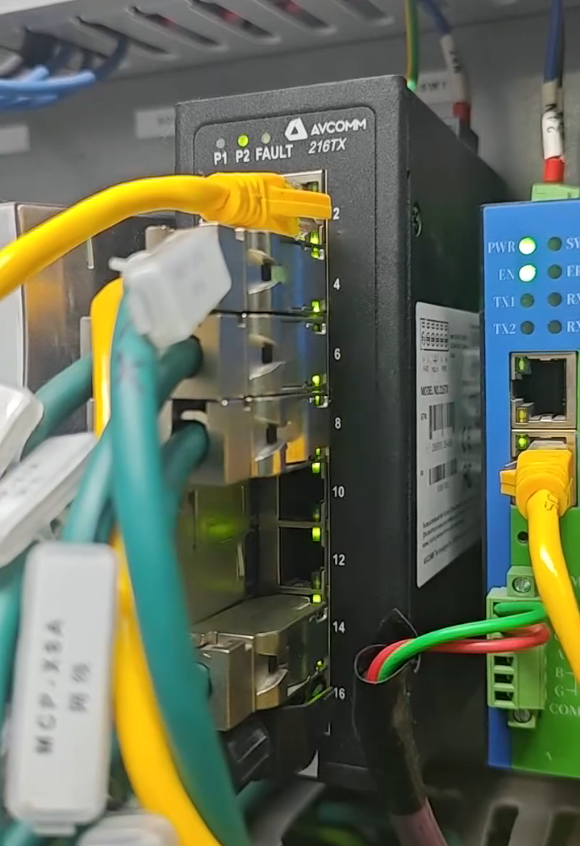
In a real-world project for an advanced automation equipment manufacturer in Eastern China, the AVCOMM 216TX 16-port unmanaged industrial Ethernet switch was installed inside the machine control cabinet to provide local network connectivity for Rockwell PLCs, HMIs, EtherNet/IP field devices, and other automation nodes.
Its role was simple, but critical:
To connect multiple automation devices inside the control cabinet into a stable and reliable local industrial network.
Customer Background: Advanced Automation for Automotive Manufacturing
The customer is an advanced automation equipment manufacturer specializing in the design, engineering, manufacturing, and system integration of customized industrial machinery for automotive and advanced manufacturing applications.
Its core business focuses on five major areas:
Large-sheet cold stamping automation lines
Integrating six-axis robots, seven-axis robots, gantry robots, and high-speed handling systems for automated stamping processes.High-strength steel hot stamping automation lines
Combining heating furnaces, robots, and automated material-handling equipment for advanced hot-forming processes.Automotive chassis and frame manufacturing systems
Covering stamping, punching, bending, robotic assembly, and automated processing of automotive chassis and frame components.Automated loading and unloading systems for CNC machining centers
Using robotic and automated equipment to support machining processes for automotive chassis, frames, and related components.Lightweight aluminum casting and forging equipment
Including differential-pressure casting, vacuum differential-pressure casting, and large-scale semi-solid extrusion casting and forging systems.
Although these systems involve different manufacturing processes, they share several important characteristics:
large and sophisticated equipment, high levels of automation, numerous control nodes, and increasing dependence on industrial Ethernet communication.
A modern automotive automation system may include PLCs, HMIs, robot controllers, remote I/O, servo systems, and multiple EtherNet/IP field devices.
As machines become more intelligent, more data must be exchanged between them.
And as the network carries more control communication:
network reliability increasingly becomes part of overall machine reliability.
The Application: Integrating More Than Ten Automation Devices in One Cabinet
In this project, the AVCOMM 216TX was installed directly inside the automation control cabinet.
The 216TX is a 16-port unmanaged industrial Ethernet switch.

Approximately 12 Ethernet ports were used in the actual installation to connect:
Rockwell PLCs;
HMI touch panels;
EtherNet/IP slave devices;
Other automation control nodes.
The primary role of the 216TX was to provide local Ethernet integration between the automation devices inside the cabinet.
From the perspective of the entire factory network, this may appear to be only a relatively small machine-level network.
From the perspective of the automation system itself, however, the switch sits at the center of the communication architecture.
The Rockwell PLC continuously reads field-device status and exchanges control data.
The HMI retrieves information from the PLC and provides operators with real-time machine status.
EtherNet/IP devices continuously exchange cyclic data with the control system.
All of this communication depends on industrial Ethernet.
For this type of control-cabinet application, the priorities are therefore very practical:
Simple installation.
Plug-and-play operation.
Reliable long-term communication.
And additional protection when unexpected network conditions occur.
Why 16-Port Industrial Switches Are Becoming More Important
Earlier generations of automation equipment often contained relatively few Ethernet devices.
A PLC, an HMI, and several remote I/O modules could often be connected with a 5-port or 8-port switch.
That situation is changing rapidly.
More robots are being integrated into production systems.
Servo devices are becoming more intelligent.
Vision systems are increasingly common.
Remote I/O and intelligent sensors are moving toward Ethernet connectivity.
More field devices support industrial Ethernet protocols such as EtherNet/IP.
As a result, it is becoming increasingly common to find eight, ten, or even more than twelve Ethernet devices inside a single control cabinet.
This project is a typical example.
The 216TX provides 16 industrial Ethernet ports, with approximately 12 ports used in the actual system.
This provides enough connectivity for current PLCs, HMIs, and EtherNet/IP devices while leaving additional capacity for commissioning, maintenance, and future expansion.
The role of the 216TX in this type of application is therefore very clear:
It is not intended to serve as the factory core switch. It serves as the industrial Ethernet connection point inside a machine, robotic workstation, automation system, or control cabinet.
Rockwell + EtherNet/IP: The Real Test Is Continuous Operation
Another important characteristic of this application is the use of Rockwell automation equipment together with multiple EtherNet/IP devices.
EtherNet/IP is widely used in automotive manufacturing, robotics, material-handling systems, assembly lines, and other advanced automation applications.
Unlike a typical office network, an industrial control network does not simply carry file transfers or general data traffic.
PLCs continuously exchange control information with field devices.
HMIs continuously retrieve operating data.
EtherNet/IP devices must maintain communication with the controller and exchange cyclic process data.
For an industrial Ethernet switch, the real question is therefore not simply:
“Can the devices ping each other?”
The more important questions are:
Will communication remain stable after hours of continuous operation?
Will the devices still communicate reliably after days and months of operation?
Will the network remain stable when more than ten industrial devices communicate simultaneously?
In this project, the 216TX was deployed directly within the operating automation system together with Rockwell PLCs, HMIs, and EtherNet/IP field devices.
It was not simply connected to a few computers in a laboratory environment.
It became part of a real industrial control system.
For automotive automation, stamping systems, casting equipment, and robotic manufacturing applications, this type of real-world deployment provides meaningful validation.
Because industrial networking is ultimately not about a topology diagram.
It is about:
production equipment that must continue operating every day.
The Reality of the Factory Floor: Problems Are Often Unexpected
Industrial networking has one important reality:
Not every network problem is caused by failed hardware.
Problems can also come from installation, wiring, maintenance, or human error.
This project provided a typical example.
During installation, an incorrect cable connection unintentionally created a Layer 2 Ethernet loop.
A local network that was originally intended to operate normally was accidentally connected into a closed network path.
Soon afterward, communication problems appeared.
Some devices could no longer be reached reliably by ping.
For field personnel, this type of problem may not be immediately obvious.
The PLC may still be operating.
The Ethernet switch may still have power.
The cables may appear to be connected correctly.
The LINK LEDs may even remain illuminated.
Yet communication has already become unstable.
At this point, the problem may not be an individual device.
The real problem may be:
the network topology itself.
How One Incorrect Cable Can Affect an Entire Control Network
One of the major advantages of an unmanaged Ethernet switch is simplicity.
Connect power, plug in the Ethernet cables, and communication begins.
However, if an incorrect cable connection creates a Layer 2 loop, serious network problems can occur.
Broadcast packets entering the loop may be forwarded repeatedly.
As abnormal traffic continues to increase, network bandwidth and switching resources can become heavily consumed.
In severe cases, this can develop into a:
Broadcast Storm.
In a real automation environment, engineers may not initially see a clear message saying “Broadcast Storm.”
Instead, they may see:
PLC communication delays;
HMI disconnections;
EtherNet/IP communication faults;
Increased ping latency;
Packet loss;
Multiple devices losing communication simultaneously.
What makes this particularly difficult in the field is that every individual device may appear to be operating normally.
Yet one incorrectly connected Ethernet cable can affect the entire machine-level control network.
BSP: Adding Another Layer of Protection to an Unmanaged Network
This field incident also demonstrated one of the practical design features of the AVCOMM 216TX:
BSP.

When incorrect wiring creates a network loop and abnormal broadcast traffic begins to affect communication, the BSP-related DIP functionality of the 216TX can help limit the impact of broadcast traffic on the local network.
This matters in real industrial environments.
Traditional unmanaged switches emphasize:
Plug and Play.
Industrial product design, however, should also consider another practical question:
What happens if someone connects the network incorrectly?
Automation equipment goes through installation, commissioning, acceptance, maintenance, and future expansion.
Electrical engineers, automation engineers, contractors, and maintenance personnel may all work on the same system at different stages.
A well-considered industrial network design therefore should not only ask:
“Can everything communicate when everything is connected correctly?”
It should also ask:
When an operational mistake occurs, how can its impact be reduced?
From this perspective, BSP is more than another item in a specification table.
It represents a practical design philosophy for real industrial environments:
When something unexpected happens, help keep its impact under control.
An Industrial Switch Should Do More Than Forward Packets
One of the first questions engineers ask when selecting an Ethernet switch is:
“How many ports do I need?”
But port count is only the starting point.
Real industrial environments also require engineers to consider:
Can equipment status be identified quickly?
Are physical connections operating normally?
Can abnormal conditions be diagnosed efficiently?
Can the impact of abnormal broadcast traffic be limited?
Can maintenance personnel quickly distinguish between a power issue, a physical-link problem, and a communication issue?
The BSP, QoS, PWR, LINK, and related capabilities available across the AVCOMM 216TX and 200/2000 Series are designed around these practical operational requirements.
For example:
PWR Status
helps field personnel quickly identify switch power conditions.
LINK Status
helps engineers confirm whether a physical Ethernet connection has been established on each port.
QoS
provides traffic-priority capabilities for different categories of network data.
BSP
helps reduce the impact of abnormal broadcast traffic on the local industrial network.
Individually, these capabilities are relatively simple.
Together, however, they address a very practical requirement:
Industrial networking should not only be easy to install. It should also be easier to operate, monitor, diagnose, and maintain.
Why Unmanaged Industrial Switches Still Matter in Automation
As industrial networks become more sophisticated, managed industrial Ethernet switches are increasingly used in factory core networks, backbone networks, and larger industrial network architectures.
That does not mean every control cabinet requires a managed switch.
For many machine-level, workstation-level, and local automation networks, unmanaged industrial Ethernet switches continue to offer significant advantages.
Simple Deployment
No complicated software configuration is required.
Install the switch, apply power, connect the field devices, and the network can begin operating.
This reduces commissioning complexity for machine builders and automation integrators.
Lower System Complexity
Automation equipment is ultimately delivered to the end customer.
If every machine-level network depends on complex switch configuration, maintenance personnel must also understand and manage that configuration.
For many machine-level networks, simplicity and stability provide greater practical value.
Easier Standardization
Robotic workstations, stamping equipment, casting systems, CNC loading systems, and other OEM automation machines often need to be manufactured and delivered repeatedly.
The simpler and more standardized the network design, the easier it becomes to replicate the complete control architecture.
This leads to a practical product philosophy:
Unmanaged networking with industrial-oriented enhancement features.
Maintain the simplicity of an unmanaged switch while adding capabilities such as BSP, QoS, PWR, and LINK to better support real industrial environments.
In other words:
Simple, but not basic.
From One Control Cabinet to the Future of Automotive Automation
Automotive manufacturing is changing rapidly.
Large integrated casting processes are entering vehicle production.
The number of robots continues to increase.
Automation lines are becoming more sophisticated.
More field devices are communicating through industrial Ethernet.
In the past, Ethernet may have been viewed simply as another communication cable connected to a PLC.
Today, it is becoming the infrastructure connecting:
PLCs,
robots,
vision systems,
remote I/O,
servo equipment,
and intelligent field devices.
Industrial networking is therefore moving deeper into every level of the automation architecture:
inside individual machines;
inside robotic workstations;
inside control cabinets;
and throughout complete production lines.
Network reliability is no longer determined only by the factory core switch.
Every machine-level network node matters.
A 16-port industrial Ethernet switch may be installed inside a relatively small electrical cabinet.
But behind that switch may be:
a robot;
a high-speed stamping system;
a large casting automation system;
or a sophisticated automotive component manufacturing cell.
That is the real value of industrial networking.
Conclusion: Saving Time and Trouble in Industrial Automation
Among the many automation control cabinet integration projects using AVCOMM 200/2000 Series industrial Ethernet switches, this application represents a highly typical real-world deployment.
Modern production control systems are becoming increasingly sophisticated.
As PLCs, HMIs, robots, remote I/O, servo systems, and intelligent field devices become more interconnected, industrial Ethernet is becoming an essential part of the overall automation architecture.
Advanced production systems therefore require, first and foremost:
stable and reliable industrial networking equipment.
The network must support continuous machine operation and reduce the possibility that communication infrastructure becomes a source of uncertainty in the production process.
At the same time, industrial networking products must provide standards-based connectivity and broad compatibility.
From Rockwell to Siemens and other widely deployed industrial control platforms, networking equipment needs to support standard industrial Ethernet communication and provide a dependable foundation for connecting PLCs, HMIs, and other control-system devices.
But the real industrial environment is never perfect.
A technician may connect the wrong cable.
Maintenance activity may accidentally create a network loop.
Abnormal broadcast traffic may suddenly appear.
And field engineers still need to understand whether equipment is powered, whether ports are linked, and whether the local network is operating as expected.
A comprehensive industrial network design therefore should not only ask:
“Will the network work under normal conditions?”
It should also ask:
“When something goes wrong, can the design help reduce the impact?”
And:
“Can it help engineers understand what is happening in the network more quickly?”
That is where features such as BSP, QoS, PWR, LINK, and other industrial-oriented operational capabilities provide practical value.
They are not intended to make a simple network more complicated.
Quite the opposite.
Their purpose is to make industrial networking simpler in the real world.
For AVCOMM, the objective has never been limited to connecting industrial devices.
Our product development philosophy is built around one simple idea:
Save our customers time and trouble.
Make products easier to deploy.
Help systems operate more reliably.
Help engineers identify problems more efficiently.
And help prevent an unexpected mistake from becoming a larger production issue.
This principle is not only a starting point for AVCOMM product development.
It is also becoming a long-term mission of the AVCOMM brand.
From a single control cabinet to a complete production system, a good industrial network should not create more work for the engineer.
**It should operate quietly and reliably in the background, helping the entire automation system work better.